
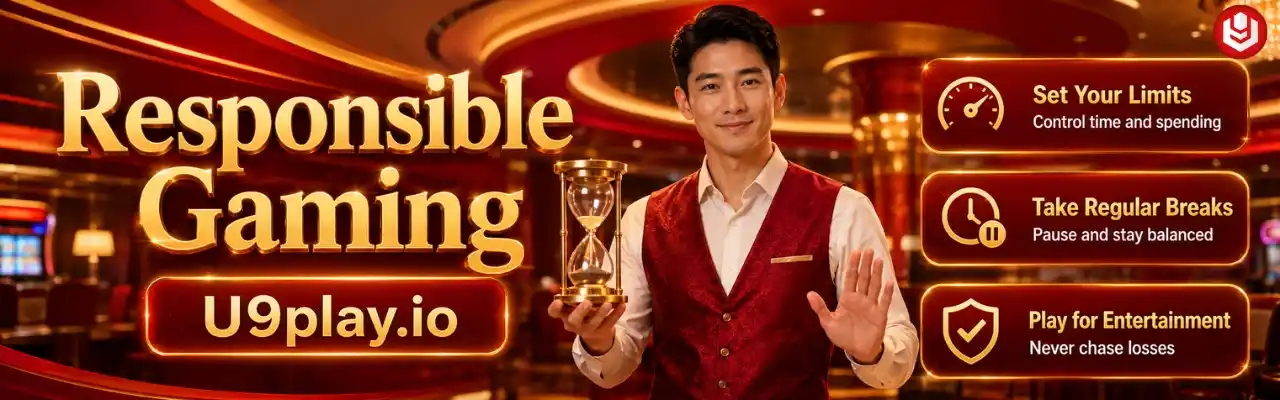
U9play Responsible Gaming
At U9play, gaming is meant to be fun. We want every member to enjoy the platform while staying mindful of the risks that come with gambling, whether financial, personal, or social.
Being a responsible player means keeping control over your time and money, remembering that no win is ever guaranteed, and knowing when to pause or ask for help.
This page covers simple ways to keep your gaming within healthy limits, plus the support available if things start to feel harder to manage.
1. Gaming Is Entertainment, Not Income
Gambling should never be seen as a way to earn a living, replace your income, or solve money problems.
Every bet carries a risk of loss. Results can’t be guaranteed, and past wins or losses never predict what happens next.
Before you play, keep these in mind:
- Only gamble with money you’re comfortable losing.
- Never touch money set aside for food, rent, bills, education, or healthcare.
- Don’t borrow money or go into debt to keep gambling.
- Don’t raise your bets just because you’ve lost.
- Set your spending and time limits before you start.
- Take regular breaks instead of playing non-stop.
2. 18+ Age Requirement
U9play is only for players aged 18 and above. By creating or using an account, you confirm that you meet this age requirement and that using our platform is permitted under the laws that apply to you.
We may ask for age or identity verification when needed. Accounts that don’t meet our eligibility rules may be restricted.
For the full eligibility details, please read our Terms & Conditions .
3. Protecting Minors
Gambling services should never be accessed by anyone under the required age. If you share a computer, phone, tablet, or other device with younger family members, take reasonable steps to prevent them from accessing your account.
We recommend that parents and guardians:
- Never share an account username, password, OTP, or verification code.
- Log out after using U9play on a shared device.
- Keep payment details out of reach of minors.
- Use device passwords, screen locks, or parental-control tools where appropriate.
- Never leave a logged-in gaming account unattended.
If you believe a person under 18 has accessed or registered an account, please contact U9play Support.
4. Set a Gaming Budget
Your gaming budget should be separate from your normal living expenses and financial commitments.
Before depositing or placing a bet, decide how much you’re prepared to lose without it affecting your day-to-day life. Once you reach that amount, stop playing instead of stretching the budget further.
Good financial habits include:
- Setting a clear entertainment budget.
- Keeping track of your deposits and spending.
- Reviewing your gaming activity regularly.
- Stopping once you reach your predetermined limit.
- Never relying on future winnings to cover current expenses.
5. Manage Your Playing Time
Responsible gaming isn’t only about money. Spending more time gambling than you intended can also be a sign that your habits are changing.
Set a time limit before starting a gaming session. Take regular breaks, and make sure gaming doesn’t interfere with sleep, work, study, family responsibilities, relationships, exercise, or other activities.
U9play encourages members to use playing-time reminders, where available, to stay aware of their gaming activity.
6. Never Chase Your Losses
Losing money can create a strong urge to keep gambling in an attempt to win it back. This is often called chasing losses.
A loss doesn’t make your next bet more likely to win. Increasing your spending after a loss usually just raises your financial risk.
If you notice you’re continuing mainly to recover previous losses, stop the session and take a break.
7. Avoid Gaming When Your Judgment Is Affected
Your decisions can become less controlled when you’re emotional, exhausted, stressed, angry, or under the influence of alcohol or other substances.
Avoid gambling when:
- You’re intoxicated or your judgment is impaired.
- You’re extremely stressed, angry, upset, or anxious.
- You’re trying to escape a personal or financial problem.
- You feel pressured by another person to participate.
- You’re unable to comfortably accept a possible loss.
8. Responsible Gaming Controls
Personal limits help create a clear boundary between entertainment and spending that’s gotten out of hand.
U9play supports responsible gaming through account-control options that may include:
- Deposit Limits – helping you manage how much money you deposit.
- Playing-Time Reminders – helping you stay aware of the time you spend gaming.
- Self-Exclusion – letting you request restrictions when you need to stop gambling.
- Account Closure – letting you request closure of your account through customer support.
If you need help with a limit, account restriction, self-exclusion, or account closure, please contact our support team through the U9play Contact page.
9. Take a Break When You Need One
Taking a break from gambling can help you regain perspective if gaming is starting to feel hard to control.
You don’t need to wait until gambling has caused a serious problem before taking action. Consider stepping away if you notice you’re spending more money, playing for longer periods, or thinking about gambling more often than you originally intended.
If a normal break isn’t enough, contact U9play Support to discuss the account restriction or self-exclusion options that may be available to you.
10. Self-Exclusion
Self-exclusion is for members who feel that temporarily or permanently stepping away from gambling is the safer choice.
You can contact our customer support team and request help with self-exclusion or account closure.
When making a responsible gaming request, clearly tell the support team that it relates to Responsible Gaming or Self-Exclusion so it can be handled appropriately.
Please don’t attempt to bypass an account restriction by opening another account.
11. Signs That Gaming May Be Becoming a Problem
Gambling habits can shift gradually. Recognizing the changes early makes it easier to take action.
Consider whether any of the following apply to you:
- You regularly gamble for longer than you planned.
- You spend more money than you originally intended.
- You repeatedly try to recover previous losses.
- You borrow money or use essential funds to gamble.
- You hide your gambling activity or spending from people close to you.
- Your gambling affects work, education, sleep, or daily responsibilities.
- You’ve lost interest in hobbies or relationships because of gambling.
- You feel irritated or restless when you can’t gamble.
- You gamble when stressed, lonely, angry, or upset.
- You continue gambling despite financial difficulties.
- You find it difficult to stop even after deciding that you should.
- People close to you have expressed concern about your gambling.
Experiencing one or more of these signs doesn’t by itself provide a diagnosis, but it may be a good reason to reduce your gambling, take a break, use account controls, or seek professional support.
12. Responsible Gaming Self-Assessment
This short self-check can help you take an honest look at your current gaming habits.
Answer each question honestly with Yes or No:
- Do you often continue gambling for longer than you planned?
- Have you spent more money on gambling than you intended?
- Do you feel a strong need to win back money after a loss?
- Have you used money intended for important expenses to gamble?
- Have you borrowed money in order to keep gambling?
- Do you hide the amount of time or money you spend gambling?
- Has gambling affected your work, education, sleep, or relationships?
- Do you feel restless, frustrated, or irritable when trying to stop?
- Do you gamble mainly to escape stress or personal problems?
- Have friends or family expressed concern about your gambling?
- Have you tried to reduce or stop gambling but found it difficult?
- Do you personally feel that your gambling may no longer be under control?
If your answers cause you concern, consider stopping gambling and contacting U9play Support about limits or self-exclusion. You may also wish to speak with an independent gambling support service or qualified professional.
Important: This self-assessment is for personal awareness only and is not a medical or psychological diagnosis.
13. Keep Gaming Separate From Your Responsibilities
Gambling should never take priority over your financial, professional, educational, family, or health responsibilities.
A useful rule is to deal with essential responsibilities first. Gaming should only take place with the discretionary time and money left over once those responsibilities are met.
14. Promotions and Bonuses
Bonuses, rebates, free spins, and other promotions should never be a reason to spend more than you planned.
Always review the promotion terms before participating, including the wagering requirements, validity period, eligible games, and withdrawal conditions.
A promotion doesn’t remove the financial risk involved in gambling and shouldn’t be treated as guaranteed profit.
15. Control Gambling-Related Marketing
If promotional messages encourage you to gamble when you’d prefer not to, reducing the gambling-related marketing you receive may help you maintain control.
If you’ve previously consented to promotional communications, you can use the unsubscribe option in those messages or contact U9play Support for help with your marketing preferences.
For more on how personal information and marketing preferences are handled, please review our Privacy Policy.
16. Account and Personal Security
Protecting your account also helps prevent unauthorized gaming activity.
- Keep your username and password private.
- Never give another person your OTP or verification code.
- Don’t allow someone else to use your gaming account.
- Log out after using a public or shared device.
- Contact support immediately if you suspect unauthorized access.
17. Friends and Family
Gambling problems can affect more than the person who is gambling. Friends and family may notice changes in behaviour, finances, relationships, or responsibilities before the individual recognizes them.
If you’re concerned about someone close to you, approach the situation calmly and encourage them to review their gaming habits, take a break, use responsible gaming controls, or seek independent professional support.
Never use another person’s U9play account or provide money specifically to help someone continue gambling.
18. When to Stop Playing
You should stop gambling if:
- You’ve reached your spending limit.
- You’ve reached your planned time limit.
- You’re trying to recover losses.
- You’re no longer enjoying the activity.
- Your emotions are influencing your betting decisions.
- Your gambling is affecting essential expenses.
- Your gambling is damaging relationships or responsibilities.
- You feel unable to control when or how much you gamble.
Stopping early is always preferable to letting a difficult situation become more serious.
19. Getting Independent Help
If gambling is causing financial, emotional, personal, or relationship difficulties, you may benefit from speaking with an independent gambling-support organization or a qualified professional.
Independent resources may include:
-
Gambling Therapy –
gamblingtherapy.org
-
Gamblers Anonymous –
gamblersanonymous.org
-
A qualified local counsellor, mental-health
professional, financial adviser, or addiction-support
service.
These organizations are independent of U9play. Their inclusion here is for informational purposes and doesn’t imply affiliation or endorsement.
If gambling is causing severe emotional distress or an immediate risk to your safety, seek urgent assistance from an appropriate local emergency or crisis-support service.
20. Responsible Gaming Support at U9play
If you would like assistance with responsible gaming, account restrictions, limits, self-exclusion, or account closure, please contact our support team.
Live Chat
Live Chat may be available through u9play.io.
Contact Page
When contacting us about gambling control, please mention Responsible Gaming Support so your request can be identified correctly.
21. Frequently Asked Questions
What does responsible gaming mean?
Responsible gaming means treating gambling as entertainment, setting your own time and spending boundaries, accepting losses without chasing them, and taking action if gambling begins to negatively affect your life.
How old do I need to be to use U9play?
U9play is available only to individuals aged 18 or above. You’re also responsible for making sure your use of online gaming services is permitted under the laws that apply to you.
What responsible gaming controls are available?
U9play supports responsible gaming through options that may include deposit limits, playing-time reminders, and self-exclusion. Support can also help with account closure requests.
What should I do if I keep trying to win back losses?
Stop gambling and take a break. Chasing losses can lead to increasingly risky spending. Consider setting stricter limits or contacting support about self-exclusion if you find it difficult to stop.
How can I request self-exclusion?
Contact U9play through our official support channels or the Contact Us page and clearly state that you want help with Responsible Gaming or Self-Exclusion.
Can I close my U9play account?
Yes. Account closure requests can be submitted through the U9play customer support team.
Where can I read U9play’s other policies?
Please review our Terms & Conditions and Privacy Policy for more on eligibility, accounts, data handling, security, and platform rules.
22. Our Responsible Gaming Commitment
U9play believes that gaming should remain controlled, informed, and recreational. We encourage every member to understand the risks of gambling, keep track of their time and spending, use available account controls when needed, and seek assistance early if gaming begins to negatively affect their life.
Being responsible doesn’t mean trying to find a better way to win. It means knowing your limits, accepting that losses are possible, and being prepared to stop.
For assistance, please visit our Contact Us page .